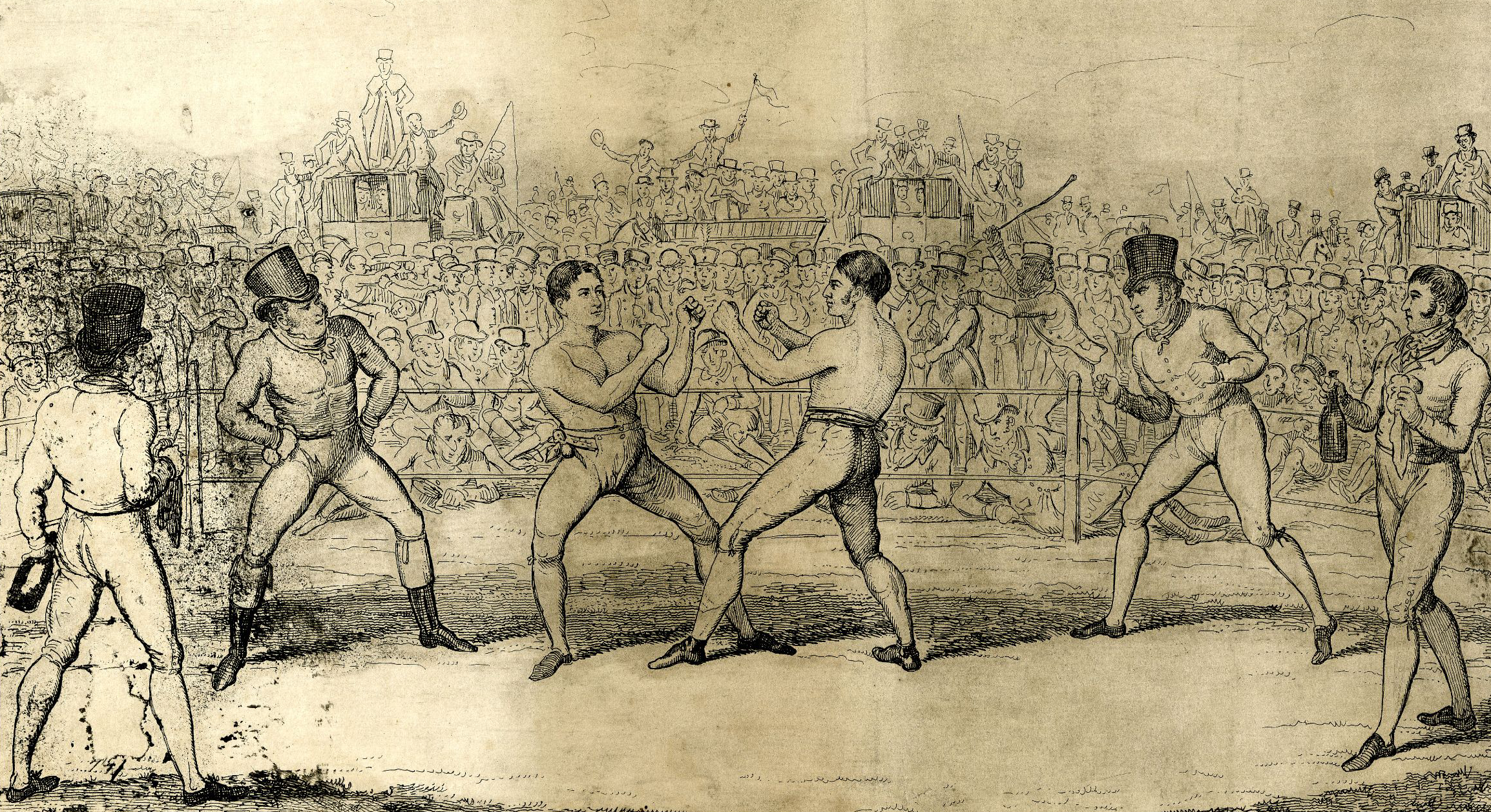
In the early 1970s, for about ten years, the Royal Oak public house in Crawley Down was renamed ‘The Prizefighters’. For that short time there was a tangible reminder in the village of the brief period in the first quarter of the nineteenth century when Crawley Down achieved fame and notoriety as a venue for prizefighting.
The sport of prizefighting grew in popularity throughout the second half of the eighteenth century, almost as a consequence of being made illegal in 1750. By the beginning of the 1800s, when Britain was at war with Napoleon, it had become a craze, with a following drawn from all levels of society. It was an almost uniquely British and colonial sport, which characterised in the minds of its devotees a patriotic brand of rugged manliness which would, they were convinced, be the ruin of Bonaparte. The boxers, or pugilists, came from humble stock, and their trades often gave them their distinctive nicknames: the Gas Man, the Master of the Rolls, the Navigator, etc. There was a strong following from the poorer sections of society, but the rich regarded prizefighting, as they did cock fighting or horse racing, as an opportunity for the excitement of the wager. In the order of £200,000 was bet on the outcome of Randall and Martin’s fight on Crawley Down in 1821.
It was with the wealthy clientele in mind that Crawley Down became a popular venue. It lay close to a turnpike road, about half way between London and Brighton, the twin centres of fashion during the Regency and the reign of George IV. Access along the lanes, however, cannot have contributed to its attraction, Sussex roads being notorious for their ghastliness. Many are the accounts of wrecked and stranded carriages and gigs seen on the morning after a fight. ‘The ring was at the end of a long, rutty and dangerous lane,’ wrote Pierce Egan of the approach to Hophurst Farm. A redeeming feature seemed to be the condition of the Down: ‘The situation was … on a rising ground; and although the weather was unfavourable [in December 1818], the turf remained in excellent order. Hundreds lay upon it regardless of the damp state of the weather.’ Egan went on to observe that ‘health or the catching of colds were not put into competition with the anxiety felt by the amateurs to see and be near to the fine tactics displayed by these renowned pugilists.’
The ‘amateurs’ were the gentlemen spectators for, in keeping with the colourfulness of its followers, prizefighting had a language all its own. The followers were ‘the fancy’ and a fight was ‘a mill’. Much of this jargon was cultivated by the sports writers of the time who, without the aid of the camera, not only had to describe the events of a prize-fight to their readers, but also the atmosphere. Regency dandies were famous for their eccentricities, and journalists of the period wrote for their readers in a style which has its modern successors.
Crawley Down, also variously known as Crawleys Down, Crawley Downs, Crawley Heath or Crawley Hurst, was not the only prizefighting venue in the area. On Copthorne Common, on December 18th 1810, the champion of England, Tom Cribb, defeated the black American, ex-slave, Tom Molyneaux, in one of the most celebrated prize-fights. There were several other prize-fights at Copthorne, as there were at Lowfield Heath, north of Crawley, and at Blindley Heath, north of East Grinstead. Sometimes the venues are confused in contemporary accounts. According to Boxiana, the fight between Tom Hickman and Tom Oliver in June 1821, took place at Blindlow (sic) Heath. However, it also stated that this location was part of Tilgate Forest, and only three miles from Crawley. A later reference in the same book says that the fight took place at Crawley Down.
Travel in those days being slow and it being about 30 miles between London or Brighton and Crawley Down, a night’s stop-over was generally necessary either before or after a fight. The large influx of spectators sought accommodation far afield, and it was not unknown for all available lodging in East Grinstead, Reigate, Godstone and Bletchingly to be taken up by early evening. Local residents did well out of this sudden demand for rooms. ‘The simple Johnny Raws, who felt no hesitation in sitting up all night if they could turn their beds to account, with much modesty only asked £1 and 15 shillings each for an hour or two’s sleep.’
With the quantity of traffic about it is a wonder that any slept at all. The ‘swells’ and ‘brilliants’ aimed to do the round trip in a day, but it was often their buggies and barouches that came to grief, racing through the mud and slush. ‘It is supposed that if the carriages had all been placed in one line they would have reached London from Crawley …’ has often been quoted, and it amply illustrates the thousands who attended many of the fights on Crawley Down, and not merely the one between Randall and Martin, in May 1819, to which it actually refers.
One problem which had always to be borne in mind by the organisers of prize-fights was the law. Because they were illegal, the fights were invariably held on lonely commons, and the venue was kept secret until only one or two days beforehand. This sometimes made it difficult for the poorer spectators, who did not have access to private transport, to reach the venues in time. The Justices of the Peace in different counties varied in their view of the sport. In his book, Rodney Stone, Sir Arthur Conan Doyle portrayed the Sussex magistrates as not prepared to ‘turn a blind eye’, but there are dangers in setting store by works of fiction. Conan Doyle placed Crawley Down in Surrey, six miles from the Sussex border, and seven miles from Hampshire; closer to the Godalming area, and some 30 miles west of its true location.
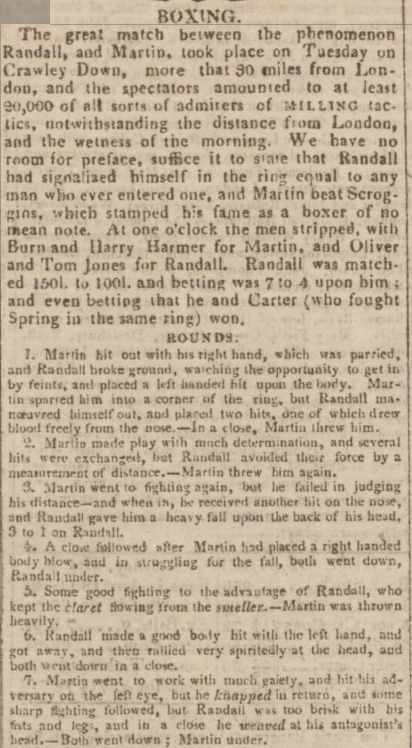
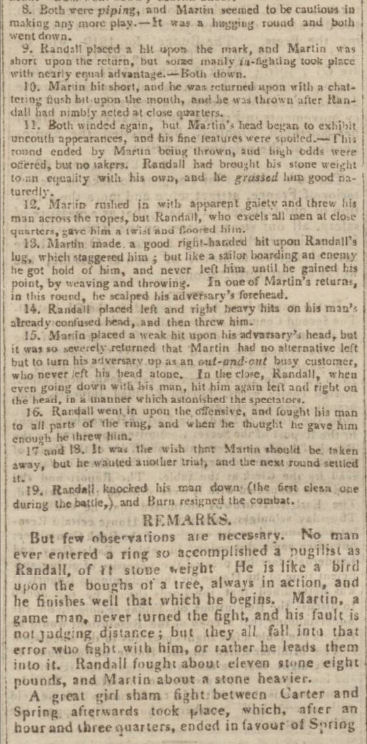
Of the fights themselves, the impression gained from the eyewitness accounts is that many of them were of immense length. The reason for this lies in the rules that were followed. Instead of fights of a fixed length, with a set number of rounds, they lasted as long as the boxers did. Rounds lasted until one boxer was knocked down. If either fighter did not come out of his corner after half a minute, the bout ended and the other was declared the winner. Some fights were over very quickly, as they can be in modern boxing. When Cooper fought Dent at Crawley Down in 1821, Cooper was bribed to make the fight last a little longer for the sake of the spectators, although he had virtually won after one round. As it was, he gave value for money and Dent did not come back after round seven. Rounds could be very short; Sampson beat Belasco in 1823 in 24 rounds, but it took only 24 minutes. Some bouts lasted a very long time. It took champion Tom Spring one hour and 55 minutes, and 71 rounds, to defeat Jack Carter. Both boxers were so exhausted that it was only by dint of remaining on his feet for slightly longer that Spring came through as the victor. On that particular occasion the crowd had good entertainment, having previously watched Randall beat Martin in 19 rounds. Unluckier were the spectators in June 1821 who also watched two fights but had to make do with a mere sixteen rounds between them. The lack of time limit on bouts meant that there could be a good deal of time wasting. It was a full five minutes before Randall and Turner came to blows and, perhaps for this reason the fight lasted all of 2 hours and 19 minutes for 34 rounds. The third round alone took thirteen minutes, and Tom Owen, one of Turner’s seconds, was recommended to have pipe to while away the time!
Not all the tactics in prizefighting have their parallels in modern boxing. Some were more similar to all-in wrestling than to the Queensbury Rules. An example is the ‘suit in chancery’ whereby a boxer would grip his opponent round the neck, underarm, holding him there to punch him until he broke loose or dropped.
The traditional site for the prize-fights at Crawley Down was a field just south of the entrance to Grange Farm, but it is difficult to visualise how any of the fields in the vicinity could have accommodated the thousands of people who are reported to have attended some of the fights. Also it seems unlikely that farmland would have been used with common land so close at hand. On report describes the prize-ring as in ‘the amphitheatre on Crawley Downs’. For the fight between Randall and Martin in 1821, a field was chosen on land belonging to a Mr Jarvis, a game purveyor, about a mile from East Grinstead. Thomas Jarvis was tenant of Hophurst Farm in 1817 and John Jarvis was the tenant in 1819, so it is likely that this was the venue. It appears that Jarvis, with the collusion of Bill Gibbons, one of the organisers, intended charging an admission fee of each spectator. The idea met with considerable opposition and it was decided, at the last minute, to move the venue to Crawley Down itself, though not before many had paid.
Of the boxers, Jack Randall, nicknamed ‘The Nonpareil’, stands pre-eminent among those who fought at Crawley Down. He won three of his undefeated record of twelve fights, on the Down, and attracted some of the largest crowds, for
‘…the favourite boy, they all agree
P. Egan, Boxiana, vol. 3 (1821)
And his name it is Jack Randall, O!’
Thomas Moore, the Irish poet and lyricist, and friend of Lord Byron, recorded in his journal that he went to watch Randall’s match against Turner in 1818. Turner’s face, he wrote, was ‘a good deal dehumanised’ but Randall’s had hardly a scratch. He also noted the predominantly male audience, musing that ‘had there been a proportionate mixture of women in the immense ring formed around, it would have been a very brilliant spectacle’. Pigeons were let off at intervals, with dispatches, presenting a picturesque sight with as many as half a dozen taking wing at once. It is said that John Keats, the poet, was brought to see Randall beat Martin in 1819, to take his mind off the death of his brother, Tom. Undoubtedly Randall’s outstanding fight was probably his shortest. He had declared that if ever his friend, Ned Turner, ‘The Out-and-Outer’, was defeated in the prize-ring he would defeat the victor. Accordingly, when Jack Martin beat Turner at Crawley Down in June 1821, Randall challenged Martin for a purse of £300, despite having been out of the ring for two years. The odds were on Martin, ‘The Master of the Rolls’ (he was a baker), but the fight was over in one round, with Martin being carried unconscious to a nearby farmhouse after suffering a ‘suit in chancery’ from Randall.
Martin also fought three times at Crawley Down, although his only victory there was over Ned Turner, which so provoked Randall. Other famous pugilists who fought on the Down were Tom Belcher, Dan Donnelly and Tom Spring. Belcher, the brother of Jem Belcher, was a Bristolian and belonged to a slightly earlier period of prizefighting. His bout against Silverthorne in 1811 was ten years before the heyday of the Down. As still happens today, Belcher retired from the ring to become the landlord of a pub.
‘Sir’ Dan Donnelly, who was supposedly knighted by the Prince Regent, was Irish champion and his fight against Tom Oliver was watched by many of his countrymen. Donnelly was known for his sportsmanship, but his skill had been somewhat of an unknown quantity until he disposed of Oliver using only his left hand. Thomas Winter, who adopted the additional name of Spring, was the successor to Tom Cribb as champion of England, a title to which Jack Randall could never aspire as he was a light-heavyweight. Spring eventually took over the Castle Inn, Holborn, from Tom Belcher.
Crawley Down was a major prizefighting venue for a mere five years, but in that time its name became synonymous with huge crowds and an atmosphere of great occasion. Henry Miles described the morning before a Berkshire prize-fight in 1829 when ‘…carriages, post chaises and gigs kept pouring through the town of Maidenhead all the morning in an almost uninterrupted line, reminding men of the days when Crawley Downs was the favourite resort of the Fancy.’
PRIZE-FIGHTS AT CRAWLEY DOWN
| Date | Pugilists | Rounds | Time |
| 21 Aug 1807 | Dutch Sam beat Tom Belcher | 36 | |
| 21 Aug 1807 | Dan Doherty beat Dick Hall | ||
| 6 Jun 1811 | Tom Belcher beat Silverthorne | 7 | 19mins |
| 5 Dec 1818 | Jack Randall beat Ned Turner | 34 | 2h 19mins |
| 4 May 1819 | Jack Randall beat Jack Martin | 19 | 49mins |
| 4 May 1819 | Tom Spring beat Jack Carter | 71 | 1h 55mins |
| 21 Jul 1819 | Dan Donnelly beat Jack Cooper | ||
| 21 Jul 1819 | Dan Donnelly beat Tom Oliver | 34 | 1h 10mins |
| 21 Jul 1819 | Lashbrook beat Dowd | 34 | 36mins |
| 5 Jun 1821 | Jack Martin beat Ned Turner | 60 | 1h 28mins |
| 5 Jun 1821 | Jack Rasher beat Joe Spencer | 70 | 1h 15mins |
| 12 Jun 1821 | Tom Hickman beat Tom Oliver | 9 | 12mins |
| 12 Jun 1821 | Jack Cooper beat Dent | 7 | 10mins |
| 16 Sep 1821 | Jack Randall beat Jack Martin | 1 | 8mins |
| 16 Sep 1821 | Jack Rasher beat Joe Spencer | 1h 48mins | |
| 16 Sep 1821 | Joe Parish beat Lashbrook | 43 | 1h 3mins |
| 8 Jul 1823 | Dick Curtis beat Peter Warren | 1 | 9mins |
| 19 Aug 1823 | Phil Sampson beat Abraham Belasco | 24 | 42mins |
| 19 Aug 1823 | Jem Garral (or Carrol) beat Whittle | 30 | 45/28mins |
| 19 Aug 1823 | Patrick Cavanagh beat Ned Stockman | 16 | 18mins |