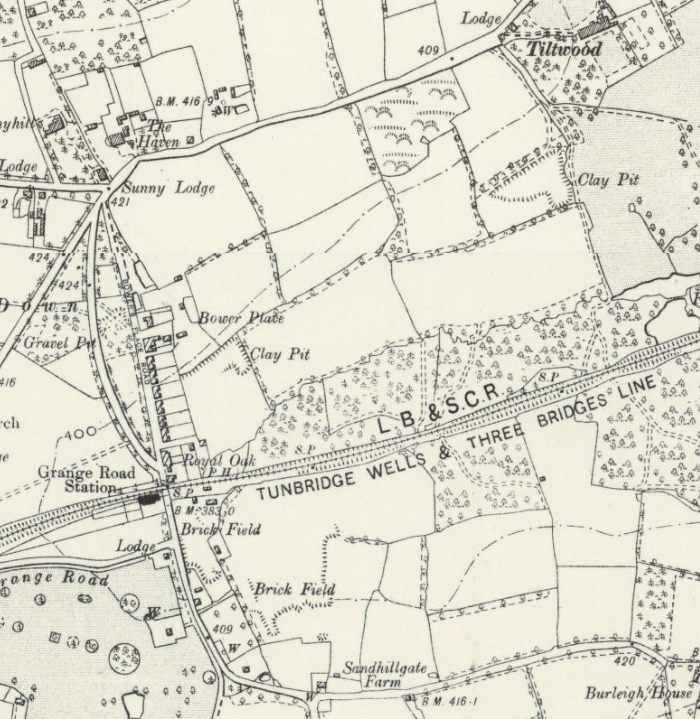
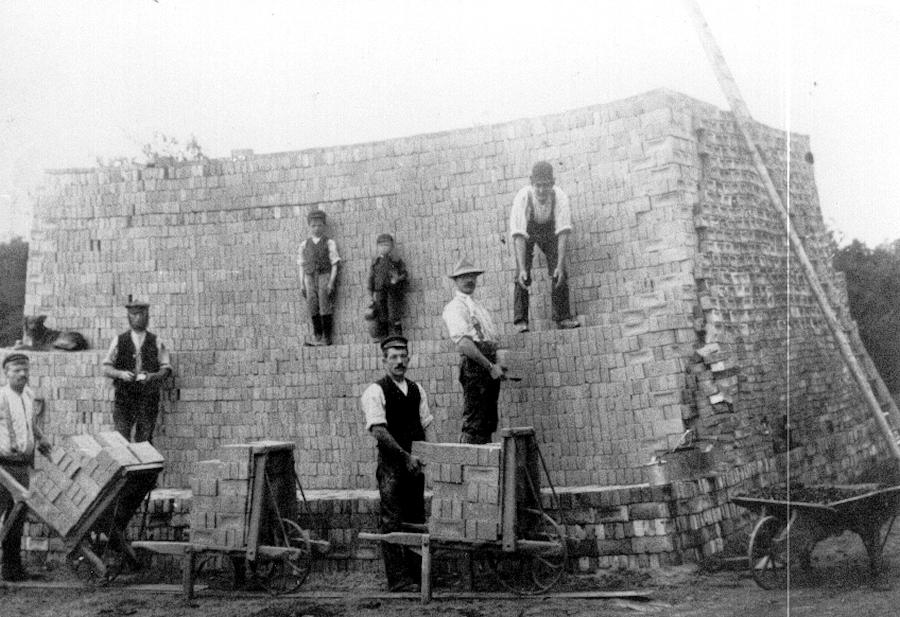
For nearly a hundred years bricks were made at Crawley Down, and provided an important but limited source of local employment. The legacy of brick making in the village lies in the names of Kiln Road and Kiln Close, Bricklands and Brickyard Lane, as well as in the steep banks behind Forest Close, Ash Close and Hawarden Close, and Bricklands, which were the quarries where clay was extracted.
The first record of brick making in the area is in the records of the building of the railway from Three Bridges to East Grinstead in 1853. Mr W. A. Commerell, who owned the land of Bower Place Farm, claimed £2260 14s. from the East Grinstead Railway Company for:
| 300,000 kiln bricks @ £2 per 1000 | £500 0s 0d |
| Brick kiln | £150 14s 0d |
| Sheds and stacks | £110 0s 0d |
| 3½ acres of brick earth 8 feet deep – as worth taken as Royalty | £1400 os od |
| TOTAL | £2260 os od |
As the railway company were anticipating spending just over £3000 on land purchases for the whole line, the sum claimed was considerably beyond what they were prepared to pay. However, they eventually settled with Mr Commerell for a payment of £300 on condition that they would construct a level crossing to link the severed parts of his land. Mr Commerell’s tenant at the time was John Riddle, who had previously been associated with a brickworks at West Hoathly in 1848. The existence of so many bricks implies that brick making had been established on the land in question (approximately the site of the Royal Oak public house) for at least a year, although the fact that in the 1851 census Riddle is recorded as having a two year old son born in Slinfold (where his landlord Commerell also had land) suggests that he can only have been tenant at Bower Place for a short time, and that the start of his tenancy may have marked the beginning of brick making in Crawley Down. John Riddle was still resident in 1858, so it is possible that he continued to make bricks, perhaps confining his operations to the area south of the railway line where brick making was to continue for the next eighty years.
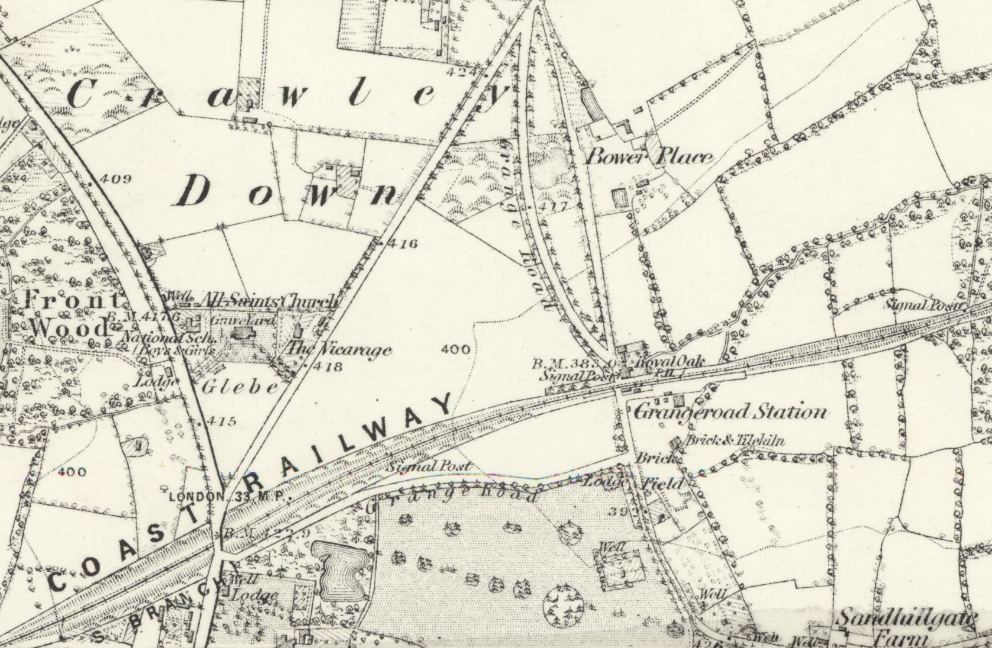
In the census of 1861 Henry Hurst is recorded as a brickmaker. He and his family hailed from Wiltshire. Ten years later William Rice, a local man, was to have the same occupation. From such scanty information it is hard to judge what status either of these men held, but is likely that they were in charge of operations at the local brickworks and that their workers were merely described as labourers.
In 1874 Samuel Ellmer was noted as a brick and tile maker. He was still there in 1882, but in addition Bennett & Rapley are recorded as brick makers at Grange Road station. It is not clear, therefore, where Ellmer’s brickyard was located, and it seems likely that he occupied the yard behind where Bowers Place now stands. Five years later, Bennett & Rapley were still there, but Ellmer had ceased business. That year, William Bennett of Turners Hill obtained a seven year lease, from George Scaramanga, of Tiltwood, of the land of Sandhill Gate Farm (now Burleigh Cottage) for digging clay and making bricks, extending the existing yard beside the old Grange Road station. The description of the land in the lease, as meadow, suggests that it had not been dug before, and that 1887 may mark the commencement of clay extraction there. John Sivyer, who is mentioned as a brick maker in 1890, probably ran his own yard, but it is not clear whether it was the one behind Bowers Place, or one further to the east.
In 1893 a one year lease for Sandhill Gate land was granted to Ambrose Bennett who, six years earlier, had been listed as a grocer. In 1895 Winter & Co. are recorded as brick makers, but two years later the land at Sandhill Gate was leased, for 21 years, to the four Smith brothers – John, George, Arthur and Harry – of South Norwood. By this time a number of buildings connected with brick making had been erected on the land. These included two brick kilns, two stables, each for three horses, a disused railway carriage used as a fowl house and store, three sheds, and a three-bedroomed bungalow with piggery and privy. In the years before the First World War, bricks made at Crawley Down were used in the construction of Larchwood, and for the building of the cottages on the north side of the western end of Sunny Avenue.
After the war the Paddockhurst Estate purchased many bricks from the Grange Road yard, and George Wells used them to build the houses along the east end of Wallage Lane, with the stone quoins coming from the Selsfield quarry which he also ran. Transporting the bricks was done on horse-drawn wagons, though later a petrol lorry was used. The lorries carried 1000 bricks at a time, which could be loaded by four men in an hour.
That at least one other brickyard was in operation at this time is evident from the appearance of another brick maker, George Hall, in 1899 and again in 1903. The yard behind Bowers Place was remembered as Hall’s yard in this period, and Alfred Bennett was foreman. In the 1920s he became foreman at the Grange Road yard, and lived in the bungalow next to the yard. Just after the turn of the century Harry Nickalls, who lived in Imberhorne Lane, began operating a small yard off Hophurst Lane, just west of Tiltwood. He had a small workforce and the yard was seldom very profitable. In an effort to compete with the many small yards in the area he charged low prices and used only horses, which he kept at the yard. Bricks from Nickalls’ yard were used in the building of the Whitehall cinema in East Grinstead (bombed in 1943). He continued into the early years of the First World War, when demand slackened drastically and the army requisitioned his horses. George Wells bought him out in 1915, his equipment was sold to the Hackenden brickworks in East Grinstead, and Webber’s, the builders, bought Nickalls’ stock of 100,000 bricks for £100.
During the First World War the Grange Road yard ceased making bricks, and a steam engine was installed to saw timber for use as trench props. George Wells took over the Smith Brothers’ lease in 1916, and in a directory of the same year three brick makers are listed; among them Albert Philpott, whose family were mainstays of brick making in Crawley Down between the wars. Wells was a builder, and he also ran the brickworks at Rowfant. He was therefore ideally placed to take advantage of the upsurge in building after the end of the war in 1918; he always maintained that he made more money out of brick making than he did out of any of his other interests. The Grange Road yard continued in use until the outbreak of war in 1939, when the use of open clamps for burning bricks was prohibited because of the blackout regulations, and uncertainty about the demand for bricks caused most small brickworks to close down. The half a million bricks there and at Rowfant were sold for making air-raid shelters and repairing bomb-damaged buildings.
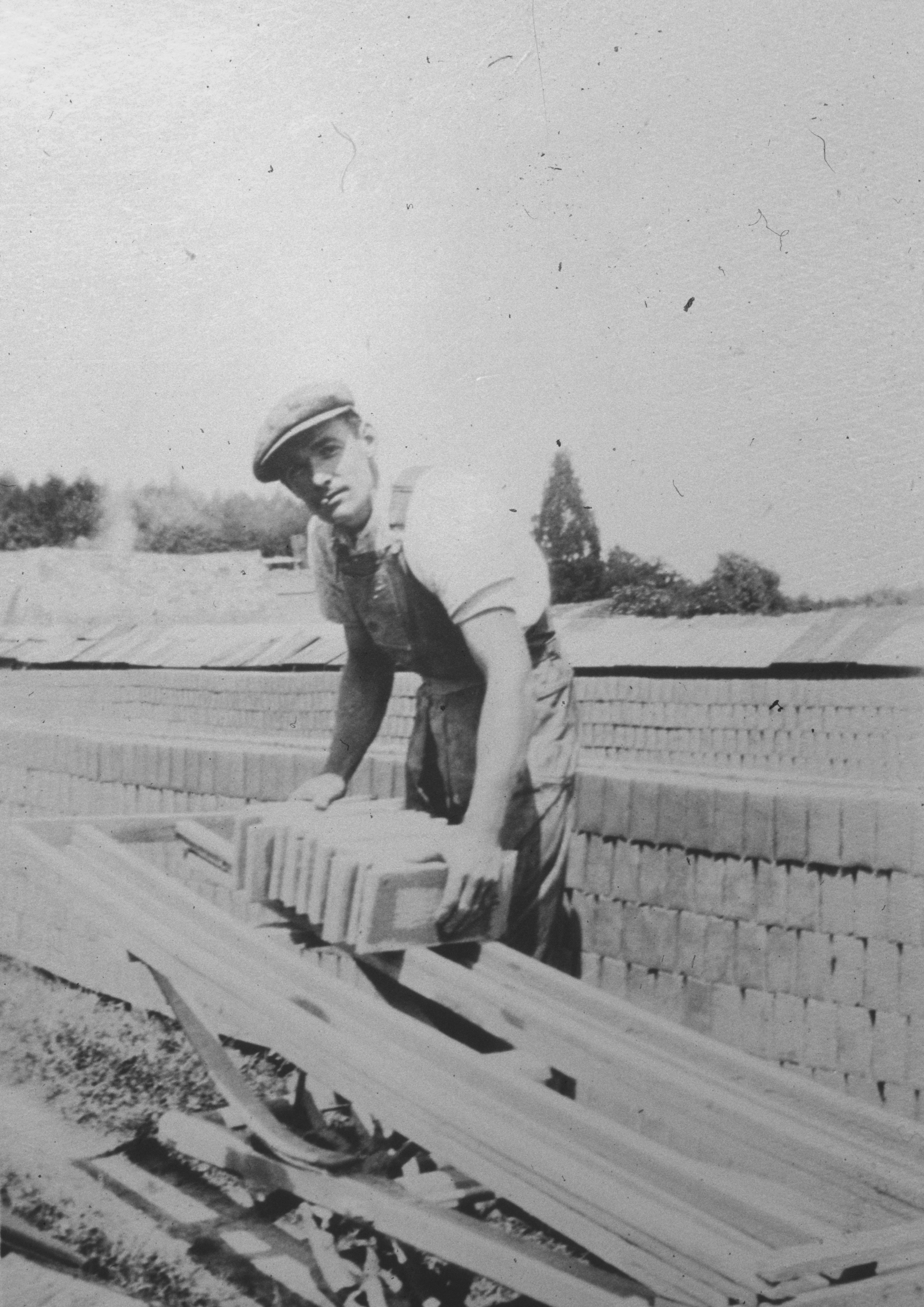
Brick making by hand involved a number stages, all of which had their specialised terms, which varied slightly from yard to yard. Clay was dug in the winter, by a few workers, and left to weather in heap about 6ft. deep in a shallow pit, known as a ‘hummocking hole’. The clay was covered with a layer of breeze, which was brought by train from the London rubbish heaps and gas works. This had to be sieved to remove any metal and glass which might have been mixed with it. The breeze stiffened the clay, and resulted in a distinctive speckled colouring.
Brick making began in late March or early April, depending on the weather. A ‘hummocker’ would take a mass of clay to the pug wheel or ‘pan’, where it would be mixed with breeze, in the proportions of 1 cu.ft. of clay to 3 cu.ins breeze, and with water from a pond, and then ground to a paste for two or three minutes. The pug wheel consisted of a cylindrical pan, about 10-12 ft. across, which rotated, and the clay was mixed by a pair of wheels set vertically, opposite each other. The ‘pan man’ would take the ‘pug’ from the ‘pan’ to a ‘stall’ where a ‘flatter-in’ would cut a small lump, or ‘walk’, of clay using a two-handled knife, called a ‘coggle’, and pass it to the brick maker. He (or sometimes she) would dust the wooden mould with sand, and then press the clay into the mould, cutting off the surplus clay, which was known as the ‘cod piece’! The mould would consist of an open wooden frame against which would be held a wooden pallet, which might have a raised surface that would form the ‘frog’ of the brick. The ‘green’ brick would then be tipped out of the mould onto another flat pallet, which would enable the brick to be placed on to a ‘bearing-off’ barrow. Carrying 32 or 34 bricks the barrow would carry them to the drying ‘hacks’. An experienced brick maker might make as many as 1700 bricks in a day, starting at four or five in the morning and continuing, with a long break in the heat of the day, until early evening. In the course of a season a brick maker might average 125,000 bricks.
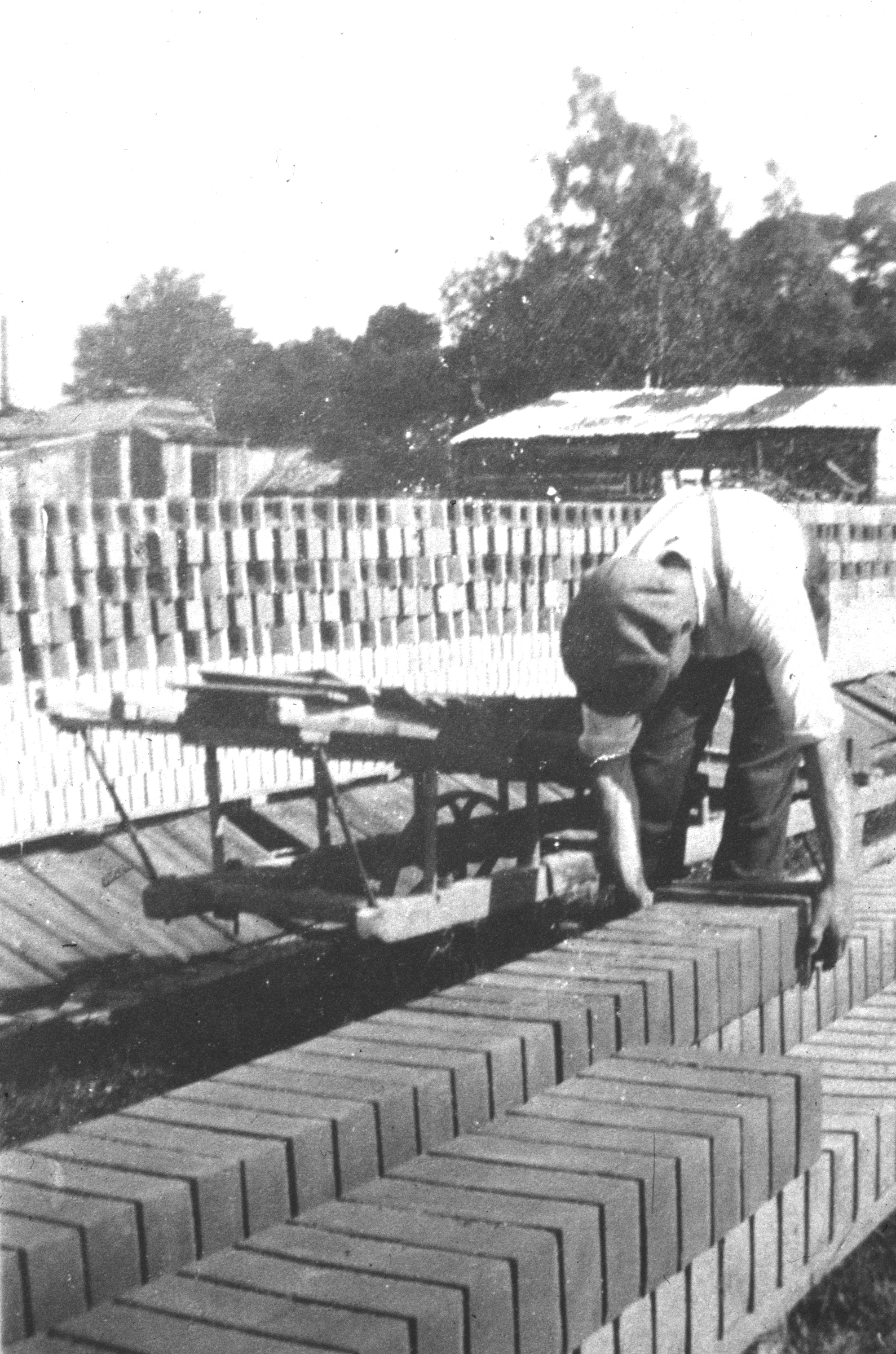
The ‘hacks’ were long, double rows of new bricks, as much as 75 yards long, where they were air dried. The length of the row allowed the bricks to dry before another row was placed on top. In good weather the ‘hacks’ could be nine or ten bricks high, with the top four or five rows ‘skintled’, or laid criss-cross. Drying would take about three weeks in good weather, and protective boards were used to keep off rain; a watch had to be kept 24 hours a day. When they were dry the bricks were taken and stacked on a clamp. This was known as ‘crowding’, and a clamp might have as many as 300,000 bricks in it. The clamp would be built on a six-inch bed of coke and airbricks, and the breeze in the brick clay would cause the bricks to be self burning to some extent.
A clamp would burn for about a month, with the quality of the bricks varying considerably within the clamp. Those on the outside, which were less well burned were sold as ‘place’ bricks for the inside walls of houses, where they would be plastered over. The better-fired bricks were sold as ‘stock’ bricks and used for facings, where their more uniform colour would enhance a building. In a good season as many as four clamps might be burnt, and again it was important that a watch was kept, round the clock, so that protective sheets of corrugated iron, or soil could be used to prevent wind or rain from affecting the combustion process. Although bricks were burnt in clamps at Crawley Down in the twentieth century, a kiln had been used before, but fewer bricks could be made at a time. Tiles and clay pipes could also be made in the kiln, which was later used variously as a wood store, blacksmith’s and lorry shed.
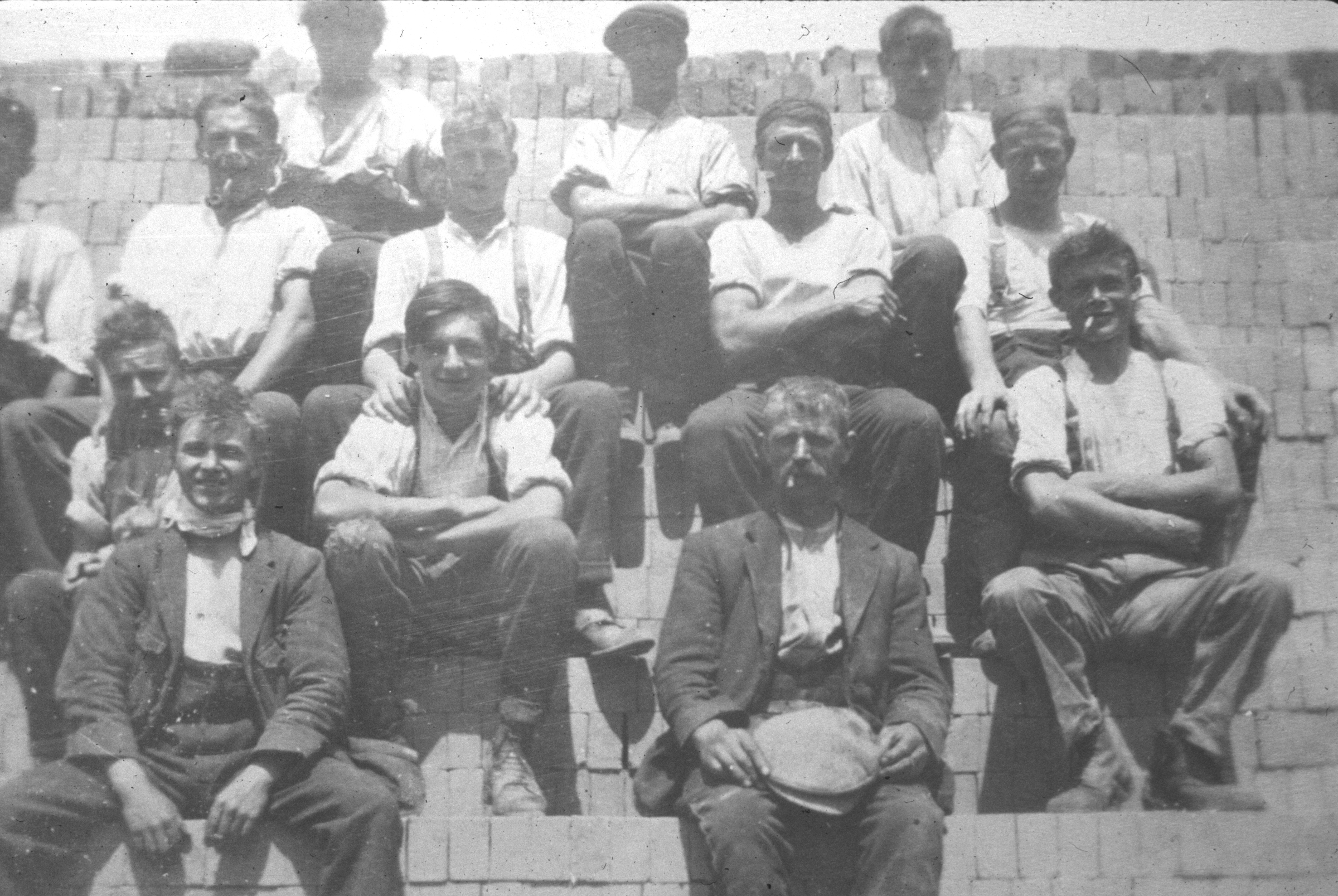
The whole process of brick making was the responsibility of the foreman or manager of the yard. Oliver Styles, the manager for Smith Brothers at the Grange Road yard in 1912, was paid 24s. 6d. (about £1.22) per 1000 bricks, and out of that payment came the earnings of all the other brick workers. The ‘hummockers’ or ‘temperers’, who mixed the clay and breeze, were paid 4s. as were the ‘crowders’, although if there were a larger number of them the money might have to be shared among them all. The five or six brick makers earned about 4s. 6d. per 1000, and they paid the ‘pan man’ 3d. a 1000 bricks to save them having to fetch the mixture themselves. By the 1920s a brick maker might expect to earn between 9s. 6d. and 11s. a 1000, while George Wells sold the bricks for £4-5 per 1000.