
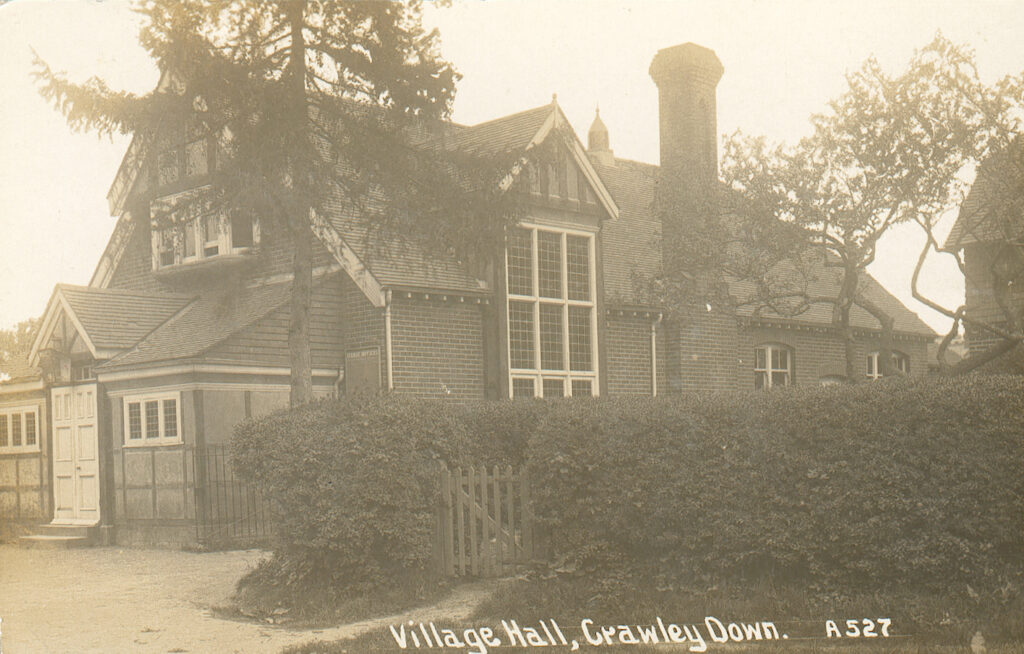
Reading of the sad demise of the Crawley Down Village Hall, and the vicissitudes that have befallen its intended replacement, has called to mind a few documents that I have come across relating to the hall’s beginnings at the end of the 19th century.
The origin of the hall was a meeting held on the 6th July 1890 at Sunny Hill (see Lost Buildings of Crawley Down). Those present were named as Messrs. Bateson, Eager and Cook, Mrs Russell, Mrs Hallett and Miss Hodgson, and at a further meeting eight days later significant progress had been made and a ten-point resolution agreed. A room was to be built for all public purposes, except religious services, subject to the discretion of a committee of management, the six persons already named. They would obtain any necessary licences and determine the rules governing the use of the premises. Local people would be invited to buy shares in the project to help fund it.
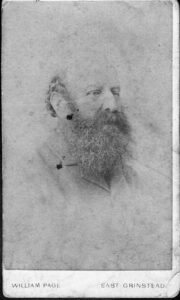
Fund raising began in earnest (see Valerie King and and Ann Read’s webpage). Raising the necessary money evidently went so well that on the 30th September that year the committee accepted the (lowest) tender of £328 for its construction submitted by Mr Samuel Webber. He was a local builder, who lived at Thorne House north of the village, on the way towards The Duke’s Head. On the 4th October the Sussex Express reported, “The erection of the Village Hall, at Crawley Down, is about to commence. The plans have been prepared free of charge by Mr. P. Chambers of Brighton.”
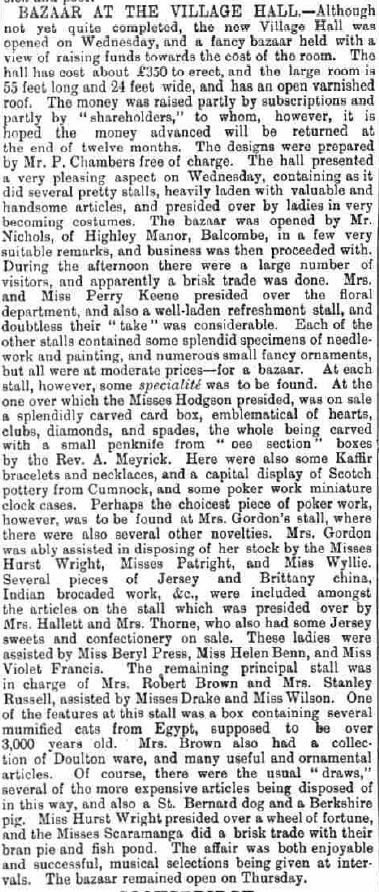
Events moved at pace and on the 23rd May 1891, with construction almost completed, the Sussex Express described in detail a fund-raising bazaar in the newly opened building. The following month it was formally named The Village Hall.
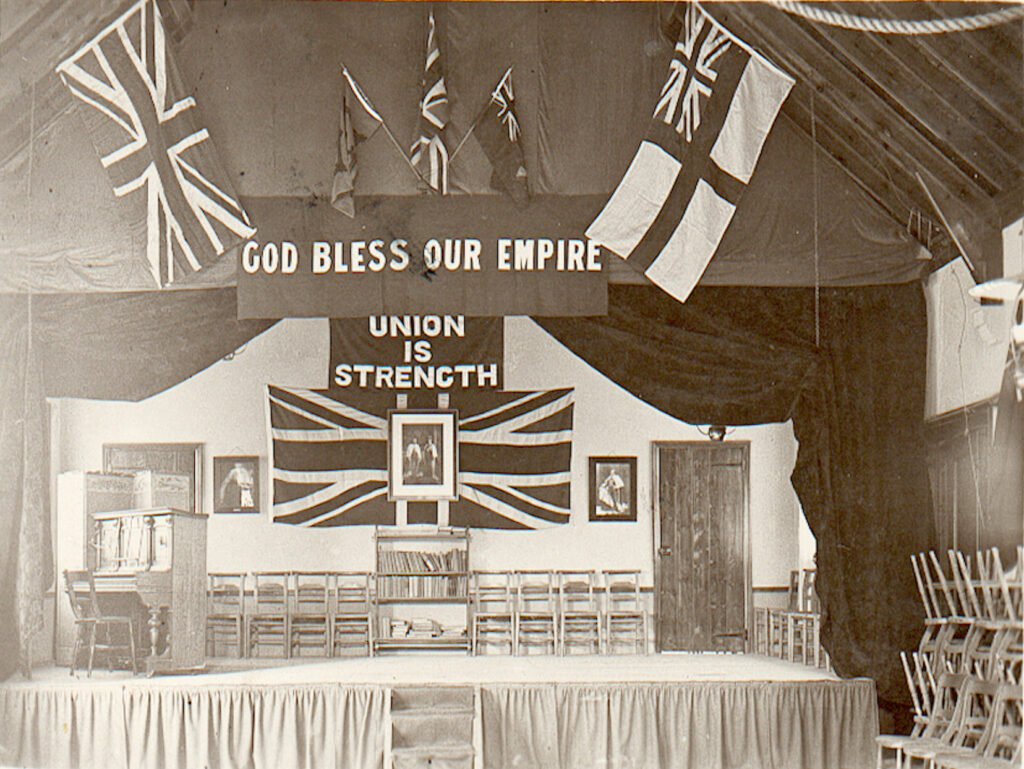
Actually, the building of the hall had cost more than the original tender, and at a meeting held at Down Park in October 1892 the final figure of £449 13s 8d was reported (about £63,000 in today’s money), all of which had been paid off. £250 had been received in donations and subscriptions in the form of shares, with the rest raised by other means. During its first 18 months the hall had been used, on average, four times a week in the Winter for a range of uses including technical instruction classes, lectures, tea parties, and concerts.
*****
One further document that will be of interest is this plan drawn up in 1926. An early extension to the Village Hall was a rifle range at the rear of the building. Although I do not know precisely when it was erected, the South African Wars will have probably influenced the decision to add it to the hall. However, with the Great War past, and in the public’s mind it was hoped that it would be ‘the war to end wars’, and perhaps a decline in its use, the decision was made to convert the range into a committee room and dwelling, which is what I remember it as when I first came to Crawley Down in 1973. It was then the home of Mr Creasey, the hall caretaker. Since then it was the Worth Parish Office for a time.
